January represents the first month of a brand-new year, 2026, and whilst many of us may be slowing down after a hectic festive season, the night sky is offering a host of wonders just waiting to be observed. This year starts off with a busy month of stargazing for us astronomers as we welcome back some familiar favorites such as, the constellation, Orion, the Wolf Moon and the Quadrantid meteor shower. In addition to these sights, this month also offers the opportunity to view a host of planets as well as some of the brightest stars in the sky.
Moon and Planets

The first full moon of the year occurs on the night of the 3rd of January. Also known as the Wolf Moon, the first full Moon of the year is also a supermoon. A supermoon occurs when a full Moon coincides with the Moon being at perigee, the closest point in its orbit to the Earth. A supermoon appears significantly larger and brighter in the night sky when compared to other full Moons. The next supermoon doesn’t occur until November this year, so it is the last chance for a while to observe the Moon at its brightest!
The Wolf Moon name is of Celtic and Old English origin, thought to be due to the increase in howling wolves during the winter months when food is scarce. Unlike other animals wolves remain active throughout the winter.
Jupiter is also visible for the majority of the month and can be found in the constellation of Gemini. Although the best night to view Jupiter will be on the 10th of January when Jupiter is in opposition, weather conditions permitting. A planet is in opposition when the planet is in the direct opposite position in the sky to the Sun, often providing the best conditions for observation. Similar to the supermoon, planets appear to be their largest and brightest when in opposition. The constellation of Gemini can be found by first locating the well-known asterism of Orion’s belt and looking to the Northeast, above Orion. The most prominent features in Gemini are the two brightest stars, Castor and Pollux, which represent the heads of the twins. Jupiter will appear brighter than the two stars, just below Pollux and will be the only non-twinkling object nearby.
Saturn is also visible in January and moves from the constellation of Aquarius to Pisces. These constellations are more difficult to spot as the stars which construct them are fainter. Pisces is the easier of the two to find, first locate the Great Square of Pegasus, a large square in the West. Following a line formed by the bottom two stars in the square to the East will lead to the circlet in Pisces. Aquarius lies slighty to the right (when looking South) of Pisces and almost directly below the Great Square of Pegasus. Saturn will be the brightest object in this region, easily identified as it will be the only object which does not twinkle.
Stars and Constellations

Orion dominates the sky during the winter months. The constellation is easily recognizable via the line of three stars which form Orion’s belt. Orion can be found by looking toward the south and is almost certainly visible at some point during the night. Hanging down from Orion’s belt is, what at first appears, to be another three stars which make up Orion’s Sheath. The middle star of these three is actually a nebula, a stellar nursery where stars are born.
If we return to Orion’s belt and follow the line formed by the stars to the West, you will notice a V-shaped pattern of stars known as Tarus or the Bull. The brightest star in this constellation is Aldebaran, a reddish-orange giant star often known as the ‘eye of the bull’. If we continue on past Tarus, remaining on the line of Orion’s belt we can find the open cluster, Pleiades, or the seven sisters. This cluster gets its name as to the naked eye it appears to be seven bright blue stars however, observing through a telescope reveals many more stars.
If we once again return to Orion’s belt and this time follow the line of stars to the East, the belt points towards Sirius, one of the brightest stars in the night sky. Sirius is actually a binary star system consisting of Sirius A and Sirius B. Sirius can be found in the constellation of Canis Major, another of the so-called winter constellations, which lies lower on the horizon throughout January. Sirius along with Procyon of Canis Minor and Betelgeuse (Orion’s left shoulder) forms the asterism, the winter triangle.
Looking to the Southeast of Betelgeuse, above Orion we can locate the constellation of Gemini with the distinctive pair of bright stars, representing the twins, Castor and Pollux. Pollux is the brightest of the two stars and the brightest in the constellation altogether. It is a giant star and to the naked eye has an orange-reddish hue. Pollux is actually a sextuple (six) star system which appears a blueish-white colour to the naked eye.
Another blueish-white star of note is Rigel, the brightest star in Orion. Rigel represents the right-foot of Orion and is a super-giant star in the later years of its life. Rigel is also a multi-star system, with at least four stars known to make up the single point of light we observe here on Earth.
If we switch our view to the North, we can now find the easily identifiable Plough of Ursa Major standing almost vertically is the sky. In this configuration, the two highest stars are known as the pointers, and following the line constructed by them to the West leads to the North Star, Polaris. Whilst Polaris represents the celestial North Pole, it is also the final star in the ‘tail’ of the constellation Ursa Minor.
If we continue on the line of the pointers, past Polaris, we can find a W-shaped pattern of stars known as Cassiopeia. Cassiopeia is one of the circumpolar constellations and can be viewed year-round in the Northern hemisphere. It is also one of the original 48 constellations listed by Ptolemy, the Ancient Greek philosopher and remains one of today’s modern constellations.
Lying almost directly below Cassiopeia, the house-shaped constellation of Cephus is readily visible with Draco barely visible on the horizon as we continue to look down. Rising in the Northeast is Leo, which again stands vertically in the night sky. Leo is identified by the ‘Sickle’ asterism, a collection of five or six stars shaped roughly like a question mark. The Great Square of Pegasus lies close to the horizon in the Northwest with the four stars, Markab, Scheat, Algenib, and Alpheratz forming the border of a square.
Meteors
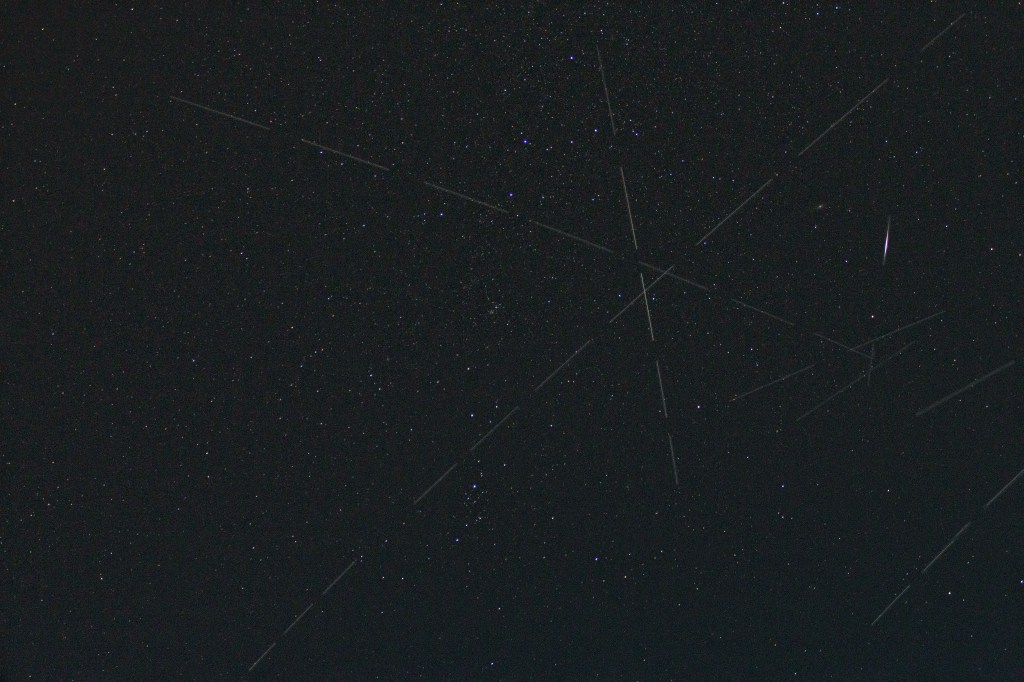
January also brings the first meteor shower of the year, the Quadrantid Meteor shower. Named after the former constellation of Quadrans Muralis, which is no longer officially recognized in the list of modern constellations. The Quadrantid meteor shower is one of the strongest meteor showers of the year, boasting a maximum rate of 110 meteors per hour.
The shower began on the 28th of December 2025 and continues until the 12th of January 2026. However, the peak of the meteor shower occurs on the night of the 3rd and 4th of January. This happens to coincide with the Full Moon which will obscure the view of all but the brightest meteors. Luckily, the Quadrantids are known for producing very bright blueish or yellowish meteors which should remain visible.
The Quadrantids originate from the asteroid 2003 EH1, a comet remnant which orbits the Sun every five and a half years, shedding dust which creates the meteors when the Earth passes through the debris field. The meteors appear to originate in Boötes which can be found by following the curve in the tail of the Plough until you find the bright orange star of Arcturus.
Final Word
A new year, and a new chance to observe the cosmos, January brings many exciting opportunities to observe for astronomers, amateurs and professionals alike! Whilst the long, dark nights remain with us, there is also plenty of time for stargazing. So, wrap up warm, get out there and happy star stargazing in this new year.
 Asterismos
Leave a comment